If you are viewing this on your phone and do not see 3 columns then scroll left/right or switch to webpage or computer view.

Showing posts with label Military Role Call. Show all posts

Tuesday, December 29, 2020

Military Roll Call: Pictures from the South Pacific.

In a 2013 review of JD’s stash of photos and pictures supplied by JL, Rex and Mary Catherine were some military pictures. I had never seen some of these before, and they will all go into the book really well. I also received a picture of Raymond Savat in Korea from Sandra. After considerable research of the pictures from the South Pacific, we have found both where some of the pictures were taken, who some of the sailors were, and found other pictures.

2020 UPDATE: I discovered a comment dated March 31, 2018, at 9:27 PM, which was not appended to this post but to another, which led to it being overlooked the last 2 years. This comment eliminates any speculation about the bakery's location. As you can see, it eliminates Romblon Island as being relevant to the question of these pictures. Their location is obviously Manila. Unfortunately, the author of the comment (the son of the bakery's owners) left the comment anonymously and has not commented further.

The comment: 

"Anonymous-March 31, 2018 at 9:27 PM. Hi GlennDL - i saw your reply to my post about the Wong's Bakery in Romblon Island, Philippines 6 year ago. I somehow revisited the blog today after 8 yrs and saw your post. I think my grandparents established The Wongs Bakery in Romblon in the 1950s, so i dont think the photo was taken in Romblon. However, before the war and immediately after they owned the same Bakery in Magdalena St, Binondo, Manila, which is not far away from Taft Avenue, so there is a possibility that is the place where the photo was taken. It is also a place where there are Calesas(horse drawn carriage exist to this day). I will research if it is indeed their bakery in Binondo. Magdalena St is now Masangkay St. and pre-war was the site of St Lukes Hospital (established by American Jesuit Nuns). Many thanks for posting the photo with the Wongs Bakery in it, I will research more and post you another update if any."


200px-USN-Seabees-Insignia.svg

The picture in front of Wong’s Bakery:

Don’t know who the three in front are, but that’s JD standing in the carriage. The only clues to where this might be in the South Pacific:

  • are the dress of JD and his ‘CB’  (SeaBee) buddies,
  • Wong’s Bakery,
  • a stained un-readable note on the back
  • and the bottle in one sailor's hand.

Wong’s bakery would probably take some serious research, and I can’t imagine Wong's bakery would be significant enough outside of its location unless it had actually survived 66 years. I tried to focus and enhance the photo to identify the bottle, but the image was in too low of a resolution. The only thing that the sailors' dress might tell us is that they probably were in the vicinity of their duty station instead of on shore leave in New Zealand, Australia, or somewhere similar. (I don’t even know if that was an option for sailors in WWII). 
Note 1         
What was a CB?

JD’s CB unit was in New Caledonia and the Fiji Islands; Tetere Beach, Guadalcanal, Emirau, New Guinea and then to Manus, New Guinea, then Manila, Philippines.

Hello! On a whim, after writing the above, I started to do a little research and discovered Wong’s Bakery in Romblon, Philippines, which is an island about 200+ miles from Manila. Wong is probably a popular name, but this was the only reference found in New Guinea, Guadalcanal, and the Philippines. This is a long shot, but the bakery was still in existence in the 60s and 70s. I’m sending an email to the blog that had this reference:
The only thing readable on the back of the picture was JD’s name and “Taff Ave.”
courtesyJohnJLLittrll (8) sharpened

Unfortunately, we have never gotten a response to the e-mail.

Hopefully, we might get JL to bring the picture to next year's reunion, and we can get a better scan.

The 1944 War film The Fighting Seabees, staring John Wayne, tells a heavily fictionalized story of the formation of the Seabees and their first taste of combat.

What follows is what we now know. 

Where was it taken:   We had speculated that JD might have been on the Romblin Island as part of the duties of a SeaBee. We have since discovered the following:

  • JD was a Ship’s Cook 3rd class (“Hq” Company, 4th Platoon). His duties would not likely take him 200 miles away to the island of Romblon. It was not taken on Romblon Island.
    • The scribbled back of the picture was mostly unreadable. The only thing for sure was the identification of JD in the carriage and the words “Taff Ave.”

We had known there was a main thoroughfare in Manila named “Taft Ave,” but we were trying to exhaust the Romblin connection first.

  • I pulled out dad’s pictures and discovered that some pictures in my already scanned box were missing from my computer—victim of one of many crashes over the years.
  • In reviewing several pictures, I discovered the following:
6-9-2013 8;17;40 PM1

Picture #1Pasay Manilla

So there is little doubt now that the picture was taken in the Manila Suburb of Pasay City on Taft Ave. The other 3 pictures were taken in the same suburb or Manila proper.

  1. A picture of JD with two buddies in what appears to be a picture gallery.
  2. Another picture, on a different day, in the same location with JD and 3 other buddies.
  3. Another picture, in a bar, of JD and two buddies. On the back was written: “Talega Posay Manila P.I.” Originally, I thought Talega was a place name. It still might be, but it isn’t in my notes, so I will have to Google it. I also thought that Posay and Talega might be the misspelled names of the two buddies with JD, but an extensive search of the 63rd CB roster and unit book turn up no similarities.
  4. When in the Philippines, the 63rd CB’s were camped in Pasay (Pasay) city, a suburb of Manila. As it turns out, Posay was a misspelling of the place name Pasay.
  5. And right there, running right through Posay City, is Taft Ave.

When was it taken: Picture #1 above says 1944 on the back. Picture #2  below is dated June 25, 1945, on the back. Picture #3 below is dated 1943 on the back. All pictures indicate the Philippines; only picture #2 appears to be in the original handwriting. We have to rule out the dates for the other two pictures as being added later through a foggy memory because the 63rd CB's didn’t arrive in the Philippines until April of 1945 and departed July 24, 1945, for the USA.

So the original picture from JL that started this conversation, as well as the other three, were all taken between April and July of 1945.

Who’s in the picture(s) with JD? The picture in the carriage with JD standing:

  • The sailor setting in front of JD is also in pictures #1 and #3.
  • The sailor standing next to the carriage is also in pictures #2 and #3. 
The sailor in front of JD is Dave English of St. Louis. He was in Company “D” 5th Platoon. He was a lifelong friend of Dad’s after the war. He visited, and we met him in the 60s and 70s, but I was too young to remember what he looks like; Dad had written his name on the back of picture #1. 6-9-2013 8;17;40 PM3
 
Picture #3 middle JD; right Dave English

I have not been able to Identify the sailor standing next to the carriage; we will call him Kilroy for now. On the back of picture #2, are four names listed, in hard to read, faded script. I will have to enhance the photo, but for now, this is what I make out:

6-9-2013 8;17;40 PM2

Picture #2

  • Curley                   Oklahoma
  • ????                       Missouri    
         (This would be our ‘Kilroy’)
  • Deal                        Alabama
  • J.D.                         Missouri

    Searching all pictures and the unit book, I could not find any Curley or any name similar to Oklahoma. Obviously a nickname, this is a total loss for now.

    We found a Deal in the company roster, Deal, D.L. of Northport, Alabama in Company C, 4th Platoon, 63rd CB's, and then found a picture that matches.

  • On the back of picture #1 with JD and Dave English, it says, “Ralph Uptgraff, St. Louis, MO..” Checked all Ralphs from Missouri, checked for Uptgraff with no success. I also looked at all the pictures in the unit book, and there were too many guys who could be this guy; none of their names were close. He could be a fellow Missourian that JD and Dave ran into from another unit? Possible Marine?


    The above information is from Military Roll Call: The Littrell Family of Mississippi County, Missouri, The Littrell Family Journals Volume IV. (click here)
    also: 
    Littrell Family Veterans Video

    reposted from 2015:  40 / 113

    Thursday, September 13, 2018

    Colonel John Luttrell: Battle Of Lindley's Mill

    excerpted from “Military Roll Call: The Littrell Familyof Mississippi County, Missouri” Chapter 1. The Revolution.
    reposted from 10-20-2015
    N Carolina (5) John is not a direct ancestor of ours, but he was a first cousin of once removed of Robert Luttrell and therefore the 2nd cousin (thrice removed) of our John Daniel Littrell).N Carolina (7) small


    As mentioned in a previous article I was unable to locate the actual Battle Field that Col. John Luttrell had died on, but had found the current location of Lindley Mills and one marker referencing the battle.
    I have located the actual location online and the following is from that website:
    "On September 13, 1781, the largest engagement of North Carolina’s “Tory War” took place near Thomas Lindley’s mill. In the aftermath of Lord Charles Cornwallis’s invasion of North Carolina in the spring of 1781, a prolonged civil conflict erupted in the Piedmont. With no regular forces actively campaigning in the area, Whig and Loyalist militias openly attacked each other as well as neutral parties. Loyalist Colonel David Fanning, leader of the Loyalist militia in central North Carolina, had received approval from British authorities in Wilmington to attack the state capital at Hillsborough. Fanning led 435 Loyalists from central and western North Carolina. He had been reinforced by two small bands of Tories from Cumberland and Bladen counties led by Colonels Archibald McDougald and Hector McNeil, raising his overall force to nearly 700 men. Battle of Lindley's Mill
          At dawn on September 12, 1781, under the cover of a heavy fog, Fanning’s men brazenly entered Hillsborough, taking the town by surprise and capturing 200 prisoners, including most of the General Assembly and Governor
    Thomas Burke. Having thoroughly plundered the village, Fanning and his men, their prisoners in tow, departed for Wilmington in the afternoon.
          Word of the disaster reached Brigadier General John Butler of the North Carolina militia that evening. Butler, who had led North Carolina militia at
    Guilford Courthouse, quickly organized men from Orange County to intercept the Tory force. Accounts differ on how many men Butler raised, but a 350-man force is the best estimate. His second-in-command was Colonel Robert Mebane, a Continental army veteran. Another Continental army veteran, Captain Joshua Hadley, arrived that evening with a small company of Whigs from Cross Creek, augmenting Butler’s force to nearly 400 men. Battle of Lindley's Mill
          Butler’s men arrived ahead of Fanning at Lindley’s Mill, near a ford across Cane Creek on a plateau overlooking Stafford’s Branch. On the morning of September 13, as the Loyalists crossed, a musket volley from the tree line on the opposite bank tore into their ranks. At first the Loyalists balked, and Colonel McNeil ordered a retreat, but was rebuked by Colonel McDougald who accused him of cowardice. McNeil, infuriated by the remark, instead led a charge toward the Whig position but was immediately cut down by rifle fire and killed.
          Hearing the gunfire at the head of the column, Fanning rode to the front, ordering the prisoners to be housed in the
    Spring Friends Meeting House in the rear. Although outnumbered, Whigs pressed the head of the Tory column back toward the chapel, apparently intent on freeing Burke and the other captives. Fanning then organized an assault that flanked Butler’s men, threatening to surround his forces. Just as he began driving Butler’s men from the field, Fanning received a serious wound in his arm that shattered the bone and severed an artery. He left the column in McDougald’s command and retired from the field. Pressed on both front and flank, Butler retreated, and Fanning’s column continued on to Wilmington with the prisoners.
          That night, local Quakers collected the dead and wounded on the field. Whig casualties consisted of 25 killed, 90 wounded and 10 captured, while the Tories lost 27 killed and 90 wounded. Surgeons from the surrounding countryside were called upon to help administer to the wounded. Among them was Dr. John Pyle, who earlier that year had led his Loyalist militia regiment into an ambush at
    Pyle’s Defeat. Putting aside his earlier allegiances, Pyle worked tirelessly for the injured of both sides. In return, Governor Alexander Martin pardoned him at war’s end."
    To place the above information in Context to Col. Luttrell the Reverend Caruthers describes the death of Colonel John Littrell and the battle:
    "Several of the highest officers on both sides were killed and nearly an equal number of each. These were men of much merit as officers, and their death was a great loss to their respective parties. On the Whig [American] side Major John Nalls and Colonel Lutteral were among the slain...."
    "...Colonel Lutteral was also killed about the close of the battle and was a great loss to the country. He is said to have been a brave and valuable officer; but his men thought him too severe in his discipline… Having advanced at the head of his men within pistol shot of a Tory from Randolph, by the name of Rains, who was in the act of loading his rifle, and fired at him with his pistol but without effect. He then wheeled his horse and dashed off, to get out of reach before the other would be ready to fire; but Rains, having finished in time, leveled his gun at him, when at full speed, and shot him through the body. He did not fall but rode to a house about half a mile distant, where the good people took him upstairs and furnished him with a bed and every comfort in their power. While lying there bleeding and dying, he dipped his finger in his own blood and wrote his name upon the wall. The house stood there as a Monument of the Cane Creek Battle and of Colonel Lutteral's death until about seven or eight years ago; and the Colonel's name retained its color and brilliance until the last. There were two men belonging to Fanning's troop by the name of John Rains, father and son, and McBride says that John Rains, SR., was killed at the battle of Cane creek…"
    sources:
    • LITTRELL and LUTTRELL HEROES In the WAR for American Independence [All Spellings]: By KARL DEWITT LITTRELL [decsd] with NANCY LITTRELL GOLDSBERRY
    • Patrick O’Kelley, Nothing But Blood and Slaughter (2004), III
    • Algie I. Newlin, The Battle of Lindley’s Mill (1975)
    • William S. Powell, ed., Encyclopedia of North Carolina (2006)
    • Eli Caruthers, Revolutionary Incidents and Sketches of Character, Chiefly in North Carolina (1854)
    • http://www.ncmarkers.com/Results.aspx?ct=ddl&k=Keywords&sv1=Keywords&sv2=Revolution

    The above information is from: Military Role Call: The Littrell Family of Mississippi County, Missouri, The Littrell Family Journals Volume IV. (click here)
    also: 
    Littrell Family Veterans Video

    999/1311

    Monday, September 10, 2018

    Two More Civil War Ancestors Discovered: Southern Unionist Served In Union Army

    updated from 10-29-17 post: typo correction.

    Stith J. Landtroop was the Uncle of our
    John Daniel Littrell and Cassandra  Urban
    was John’s grandfather.

    Farmer  Cassandra Urban [age 36] and his brother-in-law, Stith J. Landtroop [age 16], enlisted in Company B of the 1st Alabama Cavalry Regiment. three days apart (February 3-6, 1864) in Pulaski, Tennessee.

    Cassandra was described as 5’8” tall dark hair, dark eyes, and dark complexion. He is listed as deserting* in Mooresville, AL, on April 13, 1864, the same day he is also shown as ‘mustering in’ at Decatur, AL.

    dedicStith is shown as deserting* in Rome, GA, on August 15, 1864 with his carbine and equipment.

    *from Teaching History.org : “I have found that most of the men said to be deserters in the Adjutant General's reports by State and their CMSRs actually served honorably and were mustered out from a "second" regiment. I believe these men received permission to transfer but the adjutant for their "first" regiment simply failed to note the order.” this appears to be the case with Cassandra and Stith as they obviously didn’t desert.   GlennDL

    Free State of Nickajack: 

    Nickajack was made up of loosely defined regions of Alabama and Tennessee where popular sentiment remained loyal to the Union, and were decidedly anti-slavery. 

    There had been increasing talk of secession by the politicians representing wealthy plantation owners in the Black Belt. Hill country residents in the Nickajack areas, however, were typically poor dirt-farmers and rarely slave owners. They believed a war of secession would be "a war for the rich, fought by the poor," and they wanted to have nothing to do with it.

    Composed of parts of Southeast Tennessee and North Alabama, Nickajack was home to many Southern Unionists who resisted the yoke of the Confederacy and attempted to form their own state – to be called Nickajack – from parts of both states.

    The residents of these parts of Alabama and Tennessee had little in common with the wealthier parts of the state. Plantations and slaves were scarce in the Nickajack region, as was agriculture like that of the central and southern parts of Alabama and the central and western parts of Tennessee. There was little support for secession or the Confederacy in the Nickajack region.

    One in ten southern soldiers served in the Union Army.

    Southern unionists were not threatened by Lincoln’s election but saw him more as a blank slate. They were willing to give him a chance as president and did not see the federal government as any threat to their property rights.

    1stAlabama


    Family Civil War Story:

    All my life I have heard a story about how our male  ancestors had to hide in the woods during the day, come out to work the crops at night, and crawl under the house to be fed through the floor boards by the women folk, for fear of being discovered and forced to go off to war.

    When I got older and started to do research on our family history I found several flaws in the story:

    1. Virtually every southern family has such a Civil War story.
    2. The story was always assumed to be about a Littrell ancestor, but our Littrell Ancestor (Eli Literal) did serve in the Confederacy for most of the war until his death at Tunnel Hill.
    3. The children of this ancestor were two young to of ever been under threat of being forced to serve. Specifically our direct ancestor, Timmons Literal.

    I approached Aunt Onene about my concerns and she was a little offended that I doubted the story. She emphasized that she heard the story many times from her grandmother Mary Catherine Urban Literal. This further complicated the story because Mary Catherine was not married to Timmons during the Civil War, both were too young, so it couldn’t be our Timmons. At the time we had no information on our Urban ancestors serving during the Civil War.

    It wasn’t that I doubted Aunt Onene, I’m sure she heard the story from her grandmother, but I did start to think that she might be mistaken about which Grandmother. Her grandmother on her Ezell side of the family (Cynthia Poteet Ezell) was the spouse of a Civil War veteran,a southern unionist.

    It has been my experience that most family tradition/myth/stories are factual in their nature, just absent of facts after being told so many times for so long. Another family story (an Ezell story) has been handed down for generations about four brothers (three Union and one Confederate) serving during the war. As it turns out the facts are that it was an Uncle and three nephews (two were brothers). So you see, factual, but with inaccurate facts.

    The problem with the theory that it was Cynthia feeding her boys through the floorboards was that her oldest son was only 5 at the start of the war.

    At this point I accepted the possibility that the story was more than likely about a non-direct family member. An Civil War family closely connected to Mary Catherine or Cynthia. That Onene did hear it from one of them, most likely Mary Catherine, and as the story was told it it became less and less accurate.

    Until now. The discovery of above mentioned Stith and Cassandra and the information on the Nickajack region sheds new light on the story as follows:

    1. Virtually every southern family has such a Civil War story: This observation is no less true than when pointed out above, but the story of the southern unionist in the Nickajack region corresponds to the enlistment of Stith and Cassandra.
    2. The story was always assumed to be about a Littrell ancestor, but our Littrell Ancestor (Eli Literal) did serve in the Confederacy for most of the war until his death at Tunnel Hill: We rule out our Littrell ancestor because he enlisted in the Confederacy, meaning that his late age entry after years of not serving was less likely to be ideological. On the other hand with Stith and Cassandra (one was too old to be conscripted and the other too young) their decision to enlist in the northern army points towards an ideological motive. It would also point to them, at least Cassandra, having anti-slavery/secessionist motives.
    3. The children of this ancestor were to young to have been under threat of being forced to serve. Specifically our direct ancestor, Timmons Literal: Mary Catherine is brought back into the story through her mother (Susannah) by her father and uncle. As an anti-slave/anti-secessionist, Cassandra’s late enlisting could have placed him under the floorboards for the preceding years of the war. The fact was that at age 36 he still couldn’t just come out of the woods to work the farm and claim that he was no longer subject to the draft. This may have forced him to face the fact that the war was not going to end without more civic participation.  
    On the night of July 14,1862, Chris Sheats, spoke to a gathering of unionists telling his fellow Alabamians that the time had come join the army of the United States and fight the Confederacy “to hell and back again.”
    “Tomorrow morning I am going to the Union army…I have slept in mountains, in caves and caverns, till I am become musty; my health and manhood are failing me, I will stay here no longer till I am enabled to dwell in quiet at home.”

    Refusing to serve the confederacy was not a minor infraction. The penalty was anything from forced service to death. Cassandra would have had to remain hidden until the war was ended…one way or the other unless he enlisted.
    In addition, Stith’s enlistment points at the presence of another ‘under the floorboard’ family member. Stith was too young to be conscripted, but if the draft age had not been expanded by this time (even for Cassandra) it would be soon. More importantly, Stith was the youngest of Susannah’s brothers. Four of her other Landtroop uncles could have been hiding under floorboards. Susannah had 4 young children when Cassandra enlisted, which would probably have made it impossible to farm and would have necessitated her moving back in with her father or brothers. Obviously the odds are very high that she experienced the floor board story at some level.

    So as you can see it is most probable that Onene was right, she did here the story from her mother, Mary Catherine, but not about Mary Catherine’s husband, but about her father and uncles.


    The dangers of being a southern Unionist:

    Henry Tucker, a private in Company B, of the 1st Alabama Cavalry, US,(the same company as Cassandra and Stith) was arrested by the Home Guard at his home in Marion County and tortured to death. He was tied to a tree, castrated, his eyes removed and his tongue cut out before he was literally skinned alive. He is buried at Hopewell Cemetery, south of Glen Allen, Ala.

    But Tucker’s vicious death was avenged. Home Guard leader Stoke Roberts who personally directed the torture of Tucker, was eventually caught by a group of unionists near Winfield. They took a long iron spike and drove it through his mouth and out the back of his head and nailed him to the root of a big oak tree.

    note:

    In an irony not lost on modern historians, the Confederacy, created to preserve the principle of states’ rights over the primacy of the central government, instituted the draft by act of the new central government. Passed by the Confederate Congress in April 1862, it imposed manpower quotas on the individual states. Every able-bodied white male between the ages of 18 and 35 was subject to military service. Each state was required to produce a certain number of men for the Confederate armies. If a state’s quota wasn’t filled by volunteers, the men must be conscripted. In the hill counties of the Southern states, including north Alabama, volunteering fell far short of the numbers required. Frustrated at the refusal of these “tories” to see the light, Governor Frank Shorter of Alabama sent conscription parties, most composed of Home Guards, into the northern counties with leave and license to coerce their reluctant neighbors into the Confederate army. To refuse meant jail at the very least, and, quite possibly, death. To make matters worse, through much of the war north Alabama was occupied by the forces of both sides, and groups of bushwhackers, many of them deserters from both armies, sprang up to prey on the people. Farms were burned, livestock, goods and money looted, and murder was not uncommon. Little wonder, then, that these men, set upon in every conceivable way by their fellow citizens, chose to take up arms and return the favor.
                         
         
    History of the 1st Alabama Cavalry, USV
                                 Knights of the Free State of Nickajack
                                 The First Alabama Cavalry, United States Volunteers
                                 By Steve Ross         


    excerpted from:

    “Military Roll Call: The Littrell Family
    of Mississippi County, Missouri”
    Chapter 1.
    The Revolution. (click here)
    also: 
    Littrell Family Veterans Video

    and

    "Walking Among The Stones: The Littrell Family of
    Lawrence County, Tennessee & Mississippi County, Missouri

    Chapter 2. The Lost Littrell Cemetery.

    reposted from 11-5-2016:   75 / 122 / 185

    Monday, June 11, 2018

    The Littrell brothers Draft Cards World War II and Korea:

    image

    Redford Littrell: notice the description of residence “1/2 mile northwest of Anniston…” Maybe this can help us locate the farm they lived on out side of Anniston. Date: 2-16-1942, World War II.

    image

    John Daniel Littrell, JR: AKA Junior Dolan, AKA JD.  6-30-1942 the World War II draft. Issued In Union Co., KY

    image

    Leslie Albert Littrell: Uncle Les, 12-9-1946, the Korean War Draft.

    *

    Redford “NMN” Littrell: Notice the “(first name only)” notation for Uncle Red’s middle name above. The family story is that Red’s military records had the letters “NMN” in place of his middle name because he didn’t have one. This was not unusual as not everyone had a three-part name; first, middle, last. It wasn’t until the advent of Social Security that people were required to have a middle name. This was a dilemma for the Littrell family as middle names were not consistently used.

    It appears that Rubin, Red, and maybe Les didn’t initially have middle names. We aren’t sure about Les as he was named after his Uncle Leslie A. Comer who may have been Leslie Albert Comer. This is speculative though as Leslie often went by LA Comer and some in the Comer family believe the “LA” stood for Lester A.

    All the children of Kizzie & John may have had middle names but over the years just forgot them or since Kizzie and John didn’t use them they were not aware of them. This born out by the double initial names of JD and OJ. ( as late as the 1940 census JD and OJ are still referred to only by their initials.

    When faced with the need for a full three-part name we know that Rubin made up his middle name (also Albert) and when signing up for the WPA CCC Camps OJ had to make up full names for himself and JD: Oliver James and Junior Dolan. We have no idea the authenticity of Oliver James, but we now believe we have found proof that JD was actually John Daniel which would have made him John Daniel Littrell, JR., thus OJ’s use of Junior. Where he got Dolan from is a mystery.

    By the time JD did his draft card, he was already using Junior Dolan, even though this was a short time after being given that name by OJ… he is still working at the CCC camp in Breckinridge, Kentucky.

    74


    NOTES:

    This would not be the only connection between JD and Camp Breckinridge, Kentucky. After returning from Korea in 1952 he would be stationed there (in the Army) were his second son Glenn (me) was born.    more on Camp Breckinridge, KY.

    See Red’s service

    See a summary of JD’s Service

    See Les’s service

    The Boys of Anniston

    see also Boydie Thurman’s draft card

    see Grand Pa John & his brother’s WW I draft cards

    Friday, June 1, 2018

    The Littrell brothers Draft Cards World War I: John D., James C., E. Presley.

    September 12, 1918 in Lawrence County, Tennessee Grandpa John and his brothers registered for the draft.

    JDL~draftcard (2)

    John Daniel Littrell

    WWI draftcard (2)

    James Carroll Littrell

    WWI draftcard (16)

    Eli Presley Littrell


    Dated September 12th, 1918, John Daniel Littrell registered for the draft at age 33, giving his birthday as January 26th, 1884 and living in Loretta Tennessee (Lawrence County). From what I can make out he lived on Route 2. (see updated notation below*)
    His description is giving as a white, native-born, self-employed farmer. His nearest relative is shown as Grandma Kizzie (Comer) Littrell. John signed the document.
    On the reverse side of the card, John is described as medium height, medium build, blue eyes and dark colored hair. The registration card makes no references to draft status other than to state Grandpa John has not lost any limbs, eyes, or suffers from any physical disqualification. At 33 years of age and having a family it is probable that he was not under threat of conscription (the war ended 60 days after Grandpa John registered). We know from our own research and family knowledge that John never served in the military, even though he had seven sons and son-in-law's that did serve through World War II, Korea, and the Cold War.

    During World War I there were three registrations. (Grandpa John was too old for the first two.)

    • The first, on June 5, 1917, was for all men between the ages of 21 and 31.
    • The second, on June 5, 1918, registered those who attained age 21 after June 5, 1917. (A supplemental registration was held on August 24, 1918, for those becoming 21 years old after June 5, 1918. This was included in the second registration.)
    • The third registration was held on September 12, 1918, for men age 18 through 45.

    read more on the WWI draft


    Lawrence County Registration Card, Registrar's Report P.M.G.O. Form No. 1 (Red) Lawrenceburg, Lawrence County, Tennessee. Provost Marshal General (Office of)
    Rural Free Delivery (RFD) is a service which began in the United States in the late 19th century, to deliver mail directly to rural farm families. Prior to RFD, individuals living in more remote homesteads had to pick up mail themselves at sometimes distant post offices or pay private carriers for delivery. RFD became a political football, with politicians promising it to voters and using it themselves to reach voters. The proposal to offer free rural delivery was not universally embraced. Private carriers and local shopkeepers feared a loss of business. The United States Post Office Department began experiments with Rural Free Delivery as early as 1890. However, it was not until 1893, when Georgia Congressman Thomas E. Watson pushed through legislation, that the practice was mandated. However, universal implementation was slow; RFD was not adopted generally in the United States Post Office until 1902. The rural delivery service uses a network of rural routes traveled by carriers to deliver and pick up mail to and from roadside mailboxes.

    57

    Thursday, May 17, 2018

    MRC: Jesse Davis USS Cape Gloucester

    Jessie Lee Davis was a son-in-law of John & Kizzie (Comer) Littrell, husband of Leatha Mae Littrell (Davis). He served aboard the Carrier Escort USS Cape Gloucester during World War II.

    jesse navy wnameWe have very little information on the service of Jessie during WW II other than what was past down as oral history. We are in need of additional information. Obviously any military records are crucial, but even the most insignificant memory, picture, or document would be of help. Please click this link for more information on how you can contribute to this serviceperson’s or any service person’s history: MRC: Putting Together Individual Histories of Service.

    UPDATE: 5-31-2018:

    dutymapCLICK

    UPDATE: 5-28-2018

    Recently discovered World War II Draft Registration Card for Jessie Lee Davis:

    jessied

    jessied2

    The National Archives in St. Louis, Missouri; St. Louis, Missouri; WWII Draft Registration Cards for Missouri, 10/16/1940 - 03/31/1947; Record Group: Records of the Selective Service System, 147; Box: 77


    see Crew Roster below for other updates to this article

    ORIGINAL POST: 5-17-2018

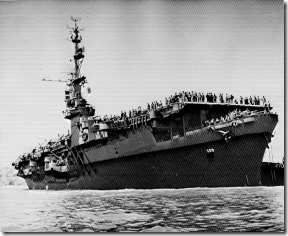
    The USS Cape Gloucester (name changed from Willapa Bay on 26 April 1944) was launched on 12 September 1944, commissioned on 5 March 1945, and reported to the Pacific Fleet.

    0310902The Cape Gloucester arrived at Leyte, Philippine Islands on 29 June 1945 to join the 3rd Fleet engaged in the Battle of Okinawa. Arriving as the battle was concluding the USS Cape Gloucester's planes flew combat air patrol fighting off Japanese kamikazes attempting to attack minesweepers operating east of Okinawa from 5–17 July. They then took part in air raids and photographic reconnaissance of shipping and airfields along the China coast until 7 August. During this time, her aircraft shot down several Japanese planes, and aided in damaging a 700-ton cargo ship.

    clip_image001After a period covering minesweeping along the Japanese coasts, and just two weeks after the Japanese formally surrendered, the Cape Gloucester sailed into Nagasaki, stripped of her planes, to serve as an early participant in the celebrated “Magic Carpet” fleet that returned thousands of ragged and half-starved prisoners of war from Australia, New Zealand, Britain and Holland, together with a handful of Americans, to their homes. Many of these POWs were from prison camps on KyÅ«shÅ«. In that role, Cape Gloucester sailed to Okinawa to unload the allied POWs, and made four voyages returning U.S. servicemen from Okinawa and Pearl Harbor to the west coast.

    0310906


    USS Cape Gloucester (CVE-109) underway off the U.S. West Coast in 1945. USN photo.;


    On a website for the USS Tyron I found a conversation that relates to the USS Gloucester and Operation Magic Carpet.

    “My Dad was captured in Singapore and sent to work on the Burma/Siam railway, after this he was railed back to Singapore and shipped to Japan on the Rakuyo Maru, torpedoed by USS Sealion, rescued by the Japanese and continued to Japan to be interned in Fukoka 25b Branch Camp in Omuta near Nagasaki. After the bomb was dropped on Nagasaki the war ended and then he was liberated by the Americans (he was British). To my knowledge he sailed from Nagasaki to Okinawa on the USS Cape Gloucester and then sailed from Okinawa (45.09.21??) via Manila, Ulithi Atoll and Hawaii en route to San Francisco. Then on to New York and back home on the Queen Mary…” 

    “…I am not 100% sure my Dad sailed to San Francisco aboard the Tryon. What I am sure of is that two other British POWs that were in the same camp as him were sent from Nagasaki to Okinawa on the Aircraft Carrier Cape Gloucester and then transferred to the Tryon some days later. With regard to the route, yes I am sure of this. I have a had written note from my Dad showing all the ‘ports of call’ from when he left England. This was written by him not long after he returned to England so I believe this is correct. The sailing date of Tryon from Okinawa is from the other two pow accounts. However I have found that many of these dates are inaccurate and can only be used as a guide…” from the son (David M.) of Sgt. Harold Madderson 848338, 135 Field Regiment, Royal Artillery

    By October 1945, Magic Carpet was operating worldwide with the Army, Navy and WSA pooling their resources to expedite the troop-lift. December 1945 became the peak month with almost 700,000 returning home from the Pacific. With the final arrival of 29 troop transports carrying more than 200,000 soldiers and sailors from the China-Burma-India theater in April 1946, Operation Magic Carpet came to its end. The last of the troops to return from the Pacific war zone (127,300) arrived home in September 1946.[4]

    Within a month of the end of Operation Magic Carpet the escort carrier USS Cape Gloucester returned to Tacoma, Wash., 22 May 1946, and was placed out of commission in reserve there on 5 November 1946

    clip_image001[6]


    USS Cape Gloucester (CVE-109)underway in 1945. By USN - U.S. Navy bureau of Ships photo 19-N-92916 from Navsource.org, Public Domain, https://commons.wikimedia.org/w/index.php?curid=39408273


    U.S.S. CAPE GLOUCESTER (CVE-109) CREW ROSTER

    • Dale, Paul: Hemet, CA
    • Beauregard,Robert: Leominster, MA
    • Davis, Jesse: East Prairie, MO
    • Carry Orcarrie: Newberryport, MA
    • Cummings, Alvin: Omaha, NE
    • Defenbaugh, Robert: Bardstown, IL**
    • Rapp, Albert: Tacoma, WA
    • Peat, Robert: North Hollywood, CA
    • Runyan, Vernon: Was K.C., Mo
    • Wolford, Charles: Omaha, NE
    • Vanfossen, Dean: Smyrna, OH
    • Hager, Lloyd: Duluth, MN**
    • Smallwood, Ken: Miamisburg, OH
    • Greenia, Fredrick Henry: Louisville, KY
    • Hayes, Paul: Dillon, SC**
    • Gregg, James: Harrisburg, PA
    • Morrow, Robert: Oconto Falls, WI

    Obviously there are many more crew members than the above list(1066 officers and men). Those listed above have been registered on the website http://www.hullnumber.com/CVE-109 by themselves or their families.

    **I have sent inquiries to all the above. The following are responses received from them to date:

    as of 5-18-2018

    “My father Lloyd John Hager (dec) served aboard the USS CAPE GLOUCHESTER (CVE-109) in 1944-45. He was an electricians mate (EM). Before joining the ship he went to boot camp in Idaho and aviation electricians training in Florida. Given the crew of over a 1000 it is unlikely he knew your uncle. Other than information about the ship and its activities which can be found on numerous websites (use correct full name above to search) the only information I can add is that he once told me that the ship held boxing matches in the hanger bay in which he participated.
    Note: the CAPE GLOUCHESTER was only in commission from late 1944 until decommissioned in 1946 so your uncle was probably onboard during that period.        Dennis L Hager, CAPT USN (ret)”

    “I am writing in reference to My Fathers assignment on CVE-109 towards end of WWII. He is still alive and has some pics and a book on CVE-109. Whether or not they were active at same time you would have to contact him for that info. I registered him on this site long time ago but he does not use computer. His name is Robert G. Defenbaugh. He was a Gunners Mate and they were in Nagasaki area after bomb drop. You could give him a call for any info you might be able to acquire. He is located in Central Illinois telephone xxx-xxx-xxxx. Be aware he is hard of hearing, 90 years old and cantankerous. He loves to talk to anyone related to CVE-109. Please identify yourself when calling and I will let him know in advance of our contact. I believe he still may have contact with others from CVE-109. Not many left.                             Robert L. Defenbaugh”

    “Dear Glenn, My father, Paul Hayes, USN passed away 5 years ago.  He was a proud member of USS Cape Gloucester.  The only information I have is that the ship sailed out of San Diego.  I wish I had more information to help you in your search. Blessings,    From Donnie Hayes, Vicar Christ Church Florence, SC”


    NOTES & SOURCES:

    The Gloucester was commissioned late in the war on 3-5-1945 and decommissioned 11-5-1946. After the war It was later repurposed as a Helicopter Carrier (CVHE-109, then a Cargo Ship and Aircraft Ferry (AKV-9) and sold for scrap in 1971.

    USS Cape Gloucester (CVE-109) anchored in mid-stream at Nagasaki, waiting to take aboard liberated Allied prisoners of war. Photographed by Private First Class L.F. DeRycke, 5 September 1945. Official U.S. Marine Corps Photograph, now in the collections of the National Archives and Records Administration (NARA), # 127-GW-1643-138641.

    USS Cape Gloucester (CVE-109) anchored in mid-stream at Nagasaki, waiting to take aboard liberated Allied prisoners of war. Photographed by Private First Class L.F. DeRycke, 5 September 1945. Official U.S. Marine Corps Photograph, now in the collections of the National Archives and Records Administration (NARA), # 127-GW-1643-138641.


    The Gloucester was a Commencement Bay-Class escort carrier built specifically for WWII.
    The escort carrier or escort aircraft carrier (US hull classification symbol CVE) was a small and slow type of aircraft carrier used in World War II. They were typically half the length and a third the displacement of larger fleet carriers. While they were slower, carried fewer planes and were less well armed and armored, escort carriers were cheaper and could be built quickly, which was their principal advantage. However, the lack of protection made escort carriers particularly vulnerable and several were sunk with great loss of life.
    Escort carriers were too slow to keep up with the main forces consisting of fleet carriers, battleships, and cruisers. Instead, they were used to escort convoys, defending them from enemy threats such as submarines and planes. In the invasions of mainland Europe and Pacific islands, escort carriers provided air support to ground forces during amphibious operations. Escort carriers also served as backup aircraft transports for fleet carriers and ferried aircraft of all military services to points of delivery.

    From <https://en.wikipedia.org/wiki/Escort_carrier>

    <https://en.wikipedia.org/wiki/USS_Cape_Gloucester>

    Note: After operational training at Pearl Harbor,

    https://en.wikipedia.org/wiki/Operation_Magic_Carpet

    Note: The navy hastily converted many of its warships into temporary transports, including aircraft carriers, where three-to five-tiered bunks were installed on the hangar decks to provide accommodation for several thousand men in relative comfort. The navy fleet of 369 ships included 222 assault transports, 6 battleships, 18 cruisers, 57 aircraft carriers and 12 hospital ships.[4]

    https://usstryon.wordpress.com/2012/02/07/hello-world/

    P.S.

    In 2015 based on some information I obtained from Bill Davis I began trying to research his father's service during World War II. According to Bill, Jesse Davis served on a carrier escort in DSC00595smallthe South Pacific. Bill remember the name of the escort being the Gloucester. Unfortunately, Bill was not able to provide a copy of Jessie's discharge papers which would have provided more information. As a result, all I was able to do was established that there was a USS Gloucester and it was a carrier escort. Without the discharge papers, the next best option was to look for a cruise book but I was unable to find any. I attempted to also do an online search for military records for Jesse as well as any newspaper articles that might have included him but was unable to find any such information. That does not mean that such a book or information on Jessie Davis doesn't exist. A few days ago I received an email from a website called hullbuddy.com referencing Jesse Davis. With the arrival this email I restarted the research on Jessie to see what this website had come up with, unfortunately, it turns out that this was a newsletter sent from a website that I had registered Jessie on in the hopes of somebody would respond to it. The newsletter contained an article referencing Flight Deck operations for escort carriers and aircraft carriers but nothing specifically on the USS Gloucester or Jesse Davis. But I began backtracking on the 2015 research. Fortunately, it turns out that new information has made its way on the internet, but so for not anything specifically pertaining to Jesse Davis but a significant amount of information pertaining to the USS Gloucester. Primarily pictures of the ship and a short record of movements. I also found references that prove a cruise ship book for the USS Gloucester was published1, but have not been able to find a reference to a known location of a copy of the book. But based on new information from various sources we can now piece together the above World War II record of the USS Gloucester.

    1 https://www.history.navy.mil/research/library/cruise-books/wwii-cruise-books-biblography/ship-books.html Cape Gloucester (CVE 109): U.S.S. Cape Gloucester Album: A Pictorial Log. Anon. Chicago: Rogers Printing Co., [1945?]. 107 pp., 28 cm, photos, ports. Dornbusch 1950: 866, Smith: 7168. No known copy location.

    18 / 136

    Sunday, November 19, 2017

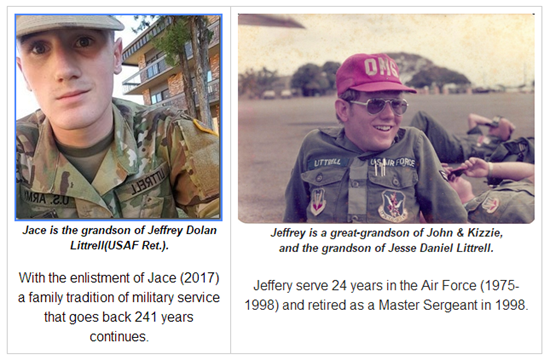
    MRC GENERATIONS: Jeffrey Littrell & Jace Showalter

    While Jeffrey served and retired from the Air Force, his grandson chose to enlist in the Army. Ironically Jace is now stationed at Goodfellow Air Force Base.
    image
    Jace also continues 73 consecutive years of unbroken military service by the descendants of John & Kizzie Littrell

    MRC Generations……a tribute to Father – Son service in the Military, but as information was compiled we discovered not just father and sons but also grandfather and grandsons, husband and wives and great-grandfathers and great-granddaughters. As a result of these discoveries we changed the name to “Generations” and present to you examples of continued multi-generational service.


    The above information for Jeffrey Littrell is from: Military Role Call: The Littrell Family of Mississippi County, Missouri, The Littrell Family Journals Volume IV. (click here)
    also: 
    Littrell Family Veterans Video
    originally posted 11-19-2017

    Saturday, November 11, 2017

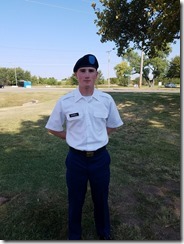
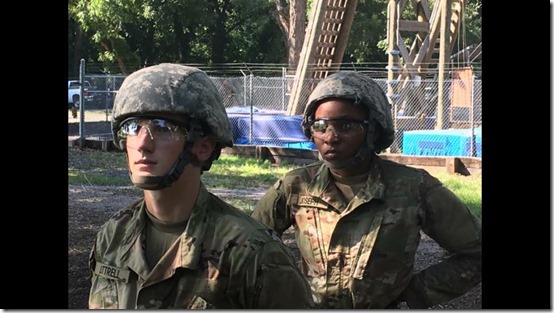
    Jace Showalter: US Army

    Jace is the grandson of Jeffrey Dolan Littrell(USAF Ret.) and the great-great-great grandson of John and Kizzie Littrell.

    With the enlistment of Jace on July 3rd, 2017 a family tradition of military service that goes back 241 years continues.

    Jace Showalter FB (1)Jace is at least the 36th family member to serve in the military since the beginning of World War II. Beginning with the 7 sons and son-in-laws of John and Kizzie who served their descendants account for 73 years of unbroken military service. Starting with Red, OJ, Jesse, Bordie and JD (World War II) and continuing with Blaine Davis, Garrett Littrell, Steven Johnson, Angela & Joel Paff and now Jace, today and into the future…

    Jace took his basic training at Fort Sill, Oklahoma and his MOS training at Goodfellow AFB where he is presently stationed.

    Jace Showalter FB (2)Jace Showalter FB (4)Jace Showalter FB (6)

    Over the last 72 years, covering 5 generations. From 1942 to 2017 there has always been a descendant (family member) of John & Kizzie Littrell in the military.

    Jace Showalter FB (14)

    originally posted 11-11-17

    43

    Military Role Call: Remember Our Veterans VIDEO:

    11-11-13 (UPDATED)

    Littrell Family Veterans


    -click the arrow to access the video-

    -if an advertisement appears on the video click the ‘X’ in the ad to remove it-
    About some in the Video

    Who Was: Col. John Luttrell?

    Frontiersmen, Soldier, Businessman.  John Luttrell was one of seven partners that formed the Henderson Company, aka The Transylvania Company, with Col. Richard Henderson.  Prior to the Revolutionary War Col. Henderson and Luttrell, at the Treaty of Watauga purchased most of Kentucky from the native Americans of the area.  Upon completion of the treaty they set out to join their employee Daniel Boone who had set out days before to blaze the trail [Wilderness Trail] into Kentucky.  Richardson, Luttrell and their party joined Daniel Boone at the founding of Ft. Boonesborough days later.  At the beginning of the Revolutionary War John Luttrell returned to his home in North Carolina and was commissioned Colonel in his colonies militia.  He served throughout the war until he was killed at the Battle of Lindleys Mill in an action against the rear guard of a 'Tory' unit who had kidnapped the governor of North Carolina.  Col. Luttrell had no children when he died leaving no descendants as attested to by lawsuits involving his widow and half brothers [including Thomas who was also at the founding of Ft. Boonseborough].
    • John Luttrell is the 2nd cousin twice removed from our ancestor Timmons Literal.  To determine your relationship to John Luttrell count the generations from Timmons to you, add two to it and you would be second cousin # removed.  For instance there is Timmons, his son John(1), my father JD(2) and then me(3).  So I'm second cousin five times removed.     for more on the Battle of Lindleys Mill

    Who Was:  Robert Luttrell?

    Robert was the great grandfather of Timmons Seburn Literal.  According to Virginia records he served 2 months and 10 as a private in Capt. Ball's company of the Fauquier County Militia in the fall of 1881.

    Rodham Literal?

    According to Lincoln County, Kentucky Records the grandfather of Timmons Seburn Literal served as Captain in the 'Cornstalk Militia'  during the summer of 1800.

    Eli Franklin Literal:

    Eli Literal served in the 9th Tennessee Cavalry during the Civil War.  The father of Timmons Literal it is believed that he died at Tunnel Hill, Georgia and was buried in a mass grave there.

    Who Was: John Pittman?

    John Pittman, of Greenwood, Ms. appears in the video in a picture with his friend JD Littrell, they served together during the Korean War.  On 11-26 1950 in fighting near Kujangdong ( Kunu Ri ) JD was wounded by grenade fragments for which he would receive his third Purple Heart. The account of that event is best illustrated in the words of the citation (Congressional Medal of Honor) that acknowledged the heroism of John Pittman who saved the lives of JD and others that night:
    “Sgt. Pittman, …volunteered to lead his squad in a counterattack to regain commanding terrain lost in an earlier engagement. Moving aggressively forward in the face of intense artillery, mortar, and JohnPittmansmall-arms fire he was wounded by mortar fragments. Disregarding his wounds he continued to lead and direct his men in a bold advance against the hostile standpoint. During this daring action, an enemy grenade was thrown in the midst of his squad endangering the lives of his comrades. Without hesitation, Sgt. Pittman threw himself on the grenade and absorbed its burst with his body. When a medical aid man reached him, his first request was to be informed as to how many of his men were hurt. This intrepid and selfless act saved several of his men from death or serious injury and was an inspiration to the entire command. Sgt. Pittman's extraordinary heroism reflects the highest credit upon himself and is in keeping with the esteemed traditions of the military service.”
    The added significance of John Pittman's heroism and a testament to the fighting in Korea was the fact that after almost a year of fighting John Pittman was the first Medal Of Honor winner in Korea to live to receive his medal.

    Who Was: Zachariah Belew?hug a vet

    Zachariah was the great great grandfather of Kizzie Zore Comer who married John Daniel Littrell, son of Timmons Literal.  He served in the South Carolina Militia as part of Col. Brandon's Regiment during the Revolutionary War.

    Who Was: Harbert H. Ezell?

    Harbert Ezell, unlike most of his family and neighbors from Lawrence County, Tennessee served in the Union Army during the civil War.  He is the grandfather of Kizzie Zore Comer who married John Daniel Littrell and Donie Ezell who married John's brother James Carroll Littrell.   

    The above information is from: Military Role Call: The Littrell Family of Mississippi County, Missouri, The Littrell Family Journals Volume IV. (click here)
    also: 
    Littrell Family Veterans Video

    reposted from 2011:   832 / 848

    END OF PAGE

    Remember, each page has a limit on how many articles can appear on that page. When you reach the bottom of a page use the “Older Post” link under the last article(ABOVE) to view/see if there are more articles.

    You can use the “Newer Post” and “Older Post” links to navigate back and forth between pages.