If you are viewing this on your phone and do not see 3 columns then scroll left/right or switch to webpage or computer view.

Showing posts with label Kissing Cousins. Show all posts

Thursday, January 11, 2018

Redneck Family Tree

reposted from 1993

     Many many years ago
     when I was twenty three,
     I got married to a widow
     who was pretty as could be.

     This widow had a grown-up daughter
     Who had hair of red.
     My father fell in love with her,
     And soon the two were wed.

     This made my dad my son-in-law
     And changed my very life.
     My daughter was my mother,
     For she was my father's wife.

     To complicate the matters worse,
     Although it brought me joy,
     I soon became the father
     Of a bouncing baby boy.

     My little baby then became
     A brother-in-law to dad.
     And so became my uncle,
     Though it made me very sad.

     For if he was my uncle,
     Then that also made him brother
     To the widow's grown-up daughter
     Who, of course, was my step-mother.

     Father's wife then had a son,
     Who kept them on the run.
     And he became my grandson,
     For he was my daughter's son.

     My wife is now my mother's mother
     And it makes me blue.
     Because, although she is my wife,
     She's my grandmother too.

     If my wife is my grandmother,
     Then I am her grandchild.
     And every time I think of it,
     It simply drives me wild.

     For now I have become
     The strangest case you ever saw.
     As the husband of my grandmother,
     I am my own grandpa!

cvcvcvc

courtesy: Douglas Baker, 1993

130

Tuesday, November 24, 2015

Simbecks are blood related to Littrell Cousins: Research notes from Deer Camp Road Trip

About 20 years ago I came across a book on the Landtroop families of America in the Indiana State Library. At the time I was not researching that line of our ancestry (Grandpa John's grand mother was a Landtroop.) so I just made a mental note to return to it later. A few years later I went back to the library looking for the book for some information and the library no longer had the book. Since then I have periodically tried to locate a copy of it, but was always unsuccessful.

At the time I first discovered the book I did not record detailed information that would have made finding the book easier. Fortunately a recent online search resulted in locating the publisher information that made a thorough search possible. This led to finding the book, now out of print, for sale on Amazon and various websites (all copies are sold out). With more accurate information it was possible to find several libraries with a copy of the book, the closest one being the St. Louis County Library.

Finding the book at the library on the last day of the Deer Camp road-trip has provided a treasure trove of information. The visit was planned for 2 hours to gather information, but it turned into a 6 hour visit that produced 30+ pages of notes and xerox copies and the possibility of a second visit at a later date.

Initial examination has provided clues to connecting/identifying at least two Landtroop families that were previously a mystery:

  • We had a newspaper clipping from 1933, a wedding announcement, that identified some Ezells, Belews, and Landtroops. There was enough information to identify a family unit, Landtroop marrying an Ezell, but we were unable to connect them to any known Landtroops or Ezells. With new information we have been able to connect the Lantroops in the article to our Landtroops. As far as the Ezells and Belews we still haven't progressed on their identification.
    click for more information

  • Many years ago Gary Littrell (<son of>Jesse<son of>John & Kizzie Littrell) provided me with a copy of a family history of the Johns/Simbeck family. The Johns/Simbeck families are connected to the Littrell family by the marriage of Jesse Littrell to the widow Viola Johns-Simbeck. Viola had two children by John Henry Simbeck, Geneva and James 'Bud' Simbeck. When Viola remarried to Jesse she had several children by him, making Geneva and Bud Jesse's stepchildren and half-siblings to Gary and the remainder of Jesse's children. Many of Geneva and Buds Littrell cousins were unaware or unconcerned that they were 'step-cousins' and not related by blood.
    In the Johns/Simbeck family history the mother of John Henry Simbeck was Elizabeth Landtroop, leading many to speculate that she might be connected to our Landtroop ancestry. The absence of any knowledge about the parents of Elizabeth prevented the discovery of that connection. Until now.
    click to see more on Elizabeth information
    We now know that Elizabeth's full-name is Elizabeth Betty Landtroop and her father is George C. Landtroop, brother of Grandpa John's grandmother, SusannaMary and George C Landtrooph L.E. Landtroop. This makes Grandpa John and John Henry Simbeck (Viola's first husband) 2nd cousins. Meaning that Jesse Littrell married the widow of his 2nd cousin, once removed. More importantly it means that Geneva and Bud are true 'blood' cousins to their Littrell cousins.
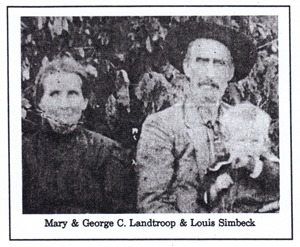
    While we have always considered Geneva and Bud among the First Cousins they are also 3rd cousins, once removed to the other First Cousins and their siblings.         
                                                                 Mary & George are Geneva & Bud’s great-grandparents
    click her to see who are the first cousins

There is much more information to process from the St. Louis County Library trip. Several generations have to be added and identified, new information on the ancestral line is now available, and questions about the large Landtroop migration to Texas need to be answered. Much of this new information dwells on Landtroop families that break off from our family line in Alabama and Tennessee.

For now the new information has helped us identify all heretofore unidentified families and individuals of the Landtroop name that were in our files and database. There are still Ezells, Belews, Urbans and even Littrell's that are still unconnected or unidentified.

The following chart is provided for the Landtroop family. It does not contain all generations, lines, or information. It just shows basic information and only shows 5 generations:

Descendants of John Lanthrop

...2 Peter Lantrop b: Bef. 1782 in Virginia, USA
    + Martha {Lantrip} b: 1780 in Virginia, USA, m: 1799 in Virginia, USA
......3 William Landtroop b: Abt. 1800 in Virginia, USA; probably Dinwiddle County
       + Charity Rainboldt
.........4 John P. Landtroop b: Abt. 1825 in Alabama, USA
.........4 Stith Jackson Landtroop b: Bet. 1826–1829
.........4 Sarah E. Landtroop b: Abt. 1834 in Tennessee, USA
.........4 Rebecca J. Landtroop b: Bet. 1839–1840 in Tennessee, USA
......3 Stith Landtroop b: Abt. 1802 in Virginia, USA;
                Probably Dinwiddie County, or Prince George County
       + Mary "Polly" Agee b: Abt. 1805 in Tennessee, USA,
                m: Jan 05, 1826 in Madison, Alabama, USA
.........4 William Smith Landtroop b: Abt. 1829 in Alabama, USA
          + Louise Elizabeth Halbert
.........4 James Thomas Landtroop b: Dec 29, 1829 in Alabama, USA
          + Martha Jane Jones
............5 John Thomas Landtroop b: Sep 11, 1872 in Limestone, Alabama, USA
............5 Mary A. S. Landtroop
............5 Elizabeth E. Lena Landtroop
............5 Martha Catherine Landtroop
............5 Lodenvia Landtroop
............5 Harriett Landtroop
............5 Malissa A. Landtroop
............5 Louisa Eugenia Landtroop
............5 Labada Landtroop
............5 Georgia W. Landtroop
............5 Rosa E. Landtroop
............5 Lula B. Lucy Landtroop
          + Nancy Kerr
.........4 Julia Ann Landtroop b: Abt. 1830
.........4 Martha J. Landtroop b: Abt. 1833
          + James Brown
.........4 Susannah L.E. Landtroop b: May 27, 1837 in Alabama, USA
          + Cassandra Urban b: Jul 04, 1831 in Alabama, USA,
                   m: 1856 in Madison, Alabama, USA
............5 Mary Catherine Urban b: Abt. 1857 ; Alabama or Tennessee ??
             + Timmons Seburn Literal
                      b: May 27, 1856 in Lawrence, Tennessee, USA; from death certificate,
                      m: Jul 25, 1877 in Lawrence, Tennessee, USA
 
                      Grandparents of Jesse Littrell
............5 John H. Urban b: Abt. 1860 in Lawrence, Tennessee, USA
............5 James C. Urban b: Feb 20, 1860 in Tennessee, USA
             + Mary E. Newton b: May 16, 1856 in Tennessee, USA,
                       m: Sep 18, 1881 in Lawrence,Tennessee, USA
............5 Martha C. Urban b: Abt. 1864
             + John Harrison Smith m: Aug 03, 1881 in Lawrence, Tennessee, USA
............5 George T. Urban b: Abt. 1866
............5 William C. Urban b: Abt. 1868 in Tennessee, USA
             + Emily Garrett b: Abt. 1867 in Tennessee, USA, m: Abt. 1888
............5 U.S.G. Urban b: Oct 1869
............5 Susan Malissa Urban b: Nov 26, 1871
             + Samuel Stutts b: Jul 15, 1871
............5 Daniel J. Urban b: Abt. 1874
             + Lola Sirvirginia Philips
............5 Thomas Marion Urban b: Oct 26, 1876
             + Mary Ann Robertson b: Nov 26, 1887
............5 Nancy L. Urban b: Dec 13, 1878
             + Claude P. Richardson b: Jan 11, 1881, m: Bef. 1898
............5 Margaret Urban b: Mar 01, 1881
             + Noah F. Robertson b: Sep 24, 1879
............5 Albert Agee Urban b: Oct 26, 1884
             + Emma b: Jul 04, 1886
.........4 Mary H. Landtroop b: Abt. 1840
.........4 John Dawson Lantroop b: Jan 09, 1842
          + [unknown spouse]
............5 Thomas Newton Lantroop b: 1868 in Lauderdale, Alabama, USA
............5 Edna Lantroop
............5 Martha Mattie Lantroop
............5 Lou Lantroop
............5 Mozella Lantroop
............5 Susan Lantroop
............5 Edward Luther Lantroop
............5 Maggie L. Lantroop
.........4 George C. Landtroop b: Nov 09, 1845 in Alabama, USA
          + Mary Neece
............5 John Henry Landtroop b: Dec 10, 1876 in Alabama, USA
............5 Marion Huston Landtroop b: Jul 15, 1879 in Alabama, USA
             + Laura Mae Fisher b: Nov 06, 1895 in Tennessee, USA,
                   m: Aug 04, 1912 in Lawrence, Tennessee, USA
............5 Elizabeth Betty Landtroop b: Oct 06, 1881 in Alabama, USA
             + Henry J. Simbeck b: Dec 05, 1879 in Tennessee, USA,
                   m: Nov 23, 1902 in Lawrence, Tennessee, USA

                   Grand Parents of Geneva and Bud
............5 Nancy Lee Landtroop b: Jul 18, 1884 in Alabama, USA
             + Elic Fisher b: Mar 02, 1893,
                   m: Oct 11, 1914 in Lawrence, Tennessee, USA
............5 Fanny Dasie Landtroop b: Abt. 1887 in Alabama, USA
............5 Frances Landtroupe b: 1889 in Alabama, USA
             + David Payne b: 1887, m: Sep 22, 1912 in Lawrence, Tennessee, USA
............5 George Landtroop b: Feb 19, 1894 in Tennessee, USA
             + Virgie Hamsley b: May 20, 1906, m: Oct 01, 1922 in Lawrence, Tennessee, USA
             + Verena Hamsley b: Oct 09, 1909
............5 Susie Landtroop
             + James R. Fowler b: Aug 22, 1878 in TN., Wayne Co.,
                    m: Jan 27, 1901 in Lawrence, Tennessee, USA
............5 William E.J. Bill Landtroop
             + Haughty Fowler
.........4 Stith J. Landtroop b: Abt. 1850
......3 Sarah Landtroop b: Abt. 1805 in Virginia, USA; probably Dinwiddle County
       + John Frick b: 1803 in Virginia, of
......3 Susan Lanthrop b: Abt. 1808 in Virginia, USA; probably Dinwiddle County
......3 Julia P. Lanthrop b: Abt. 1816 in Virginia, of; probably Dinwiddle County

Sunday, July 27, 2014

Tennessee Love Story:

Susie Lee done fell in love; She planned to marry Joe.
She was so happy 'bout it all She told her Pappy so.
Pappy told her, "Susie gal, You'll have to find another.
I'd just as soon yo' Ma don't know, But Joe is yo' half brother"
So Susie put aside her Joe And planned to marry Will.
But after telling Pappy this, He said, "There's trouble still...
You can't marry Will, my girl,
and please don't tell your Mother,
but Will and Joe
and several mo' I know is yo' half brother"
But Mama knew and said, "My child, Just do what makes yo' happy.
Marry Will or marry Joe.
You ain't no kin to Pappy     
courtesy of Kelly [so blame her]

reposted from 2012

Sunday, July 28, 2013

Kissing Cousins: The Exaggerated Myth of Intermarriage.

The stereotype of hill folk, or ‘hillbilly’, engaging in intermarriage is both unfairly associated with them as an exclusive trait and exaggerated as a common tendency.

Even the term ‘hillbilly’ is (often seen as a derogatory label) has grown into an equally unfair stereotype in spite of its origins having nothing to do with the people of rural, mountainous  areas of Appalachia and the Ozarks.

Hillbilly: The term originated in 17th century Ireland for Protestant supporters of King William III. The Irish Catholic supporters of James II referred to these northern Protestant supporters of "King Billy", as "Billy Boys". However, in America hillbilly was first used in 1898, which suggests a later, independent development."

Use of the term outside the Appalachians arose in the years after the American Civil War, when the Appalachian region became increasingly bypassed by technological and social changes taking place in the rest of the country. Until the Civil War, the Appalachians were not significantly different from other rural areas of the country. After the war, as the frontier pushed further west, the Appalachian country retained its frontier character, and the people themselves came to be seen as backward, quick to violence, and inbred in their isolation.

The "classic" hillbilly stereotype – the poor, ignorant, feuding family with a huge brood of children tending the family moonshine still – reached its current characterization during the years of the Great Depression, when many Appalachian mountaineers left their homes to find work in other areas of the country. The 1930s through the 1950s, saw many mountain residents moving north to the Midwestern industrial cities of Chicago, Cleveland, Akron, and particularly Detroit, where jobs in the automotive industry were plentiful. This movement north became known as the "Hillbilly Highway". The same period saw similar migrations from the Ozarks and other poor rural folk such as the Okees from dustbowl destroyed communities migrating west to California. As is true with any derogatory and hate filled stereotype the term Hillbilly and Okee grew to mean any person or group of person that was viewed negatively, regardless of origin or circumstance. The advent of the interstate highway system and television brought many previously isolated communities into mainstream United States culture in the 1950s and 1960s. The Internet continues this integration.

The stereotype of intermarriage, like many stereotypes is born out of ignorance, repetition of unfounded facts and generalities.

As any genealogist can attest to the presence of many families with the same surname does not prove a family connection. As often as not for every  person of a certain surname decent marrying a person of the same surname decent the connection goes so far back as to make the term intermarriage inappropriate even if it is technically correct. In many cases the connection is so many generations removed that finding a connection of two surnames in an isolated area requires going back generations to before the migration to that isolated area. Two Smiths in the same community may derive from two families that were previously in two different states. 

That isn’t two say that all or even a majority of surnames marrying surnames didn’t involve the re-crossing of bloodlines. It happened, but the emphasis on brother marrying sister or aunt was an offensive exageration. The labeling of this as a hillbilly trait would be to ignore the preexistence of the practice of marrying a relative. It is biblical and it is part of the heritage of any descendent of European immigrants. Intermarriage to maintain property and title rights goes back to the dark ages of European history as it was not unusual for nobles and monarchs to get the Pope’s, or church’s sanction of a marriage by making an exception to or acceptance of such and arrangement.

Another contributing factor to the practice of intermarriage being widespread in less populated or isolated areas is our misunderstanding of the original or archaic definition of words that have different connotations in different eras.

  1. The titles Jr. (junior) and Sr. (senior) are used very differently now than they were a hundred or more years ago. Today the titles have come to be parts of our names. John, Sr. and John, Jr., mean father and son, but a hundred (or less) years ago they were mere sub-titles, placeholders or descriptive words attached to names for purposes other than distinguishing between father and son.

    Typically if there was a father and son in a community they would be referred to as John Smith the father or John Smith the son. This is how in more ancient times, before the common use of surnames existed, such surnames as Smithson came about ( historical example: the Viking Eric, and his son Leif Ericson). If they were not father and son they might be distinguished by the term ‘the elder’ or ‘the younger’, but that practice also declined for the same reason that ‘the father’ and ‘the son’ did, people began adopting Elder and Younger as surnames.

    In pre-1900 America if there were two John Smith’s in a community or on a document, whether they were father and son or not, they would be distinguished from each other as senior or junior, based on age, not relationship. In family history research failing to understand the use of these word leads to misidentifying family lines. Accepting the misuse of the terms Sr., and Jr., not only led to false identification of father and son connections but also to the misidentification of marriages between descendents of a sibling and another misidentified non-sibling. Contributing to the intermarriage myth as being more common that it truly was. *note
  2. Similarly, the title ‘cousin’ has a long history of mis-use. In more ancient times it included everyone from a distant aunt or uncle, in-law,  family friend, to the modern use of the child of our uncle or aunt. This practice was common from the first foot placed on Plymouth Rock to the early 1900s. Common examples to these varied uses can be seen in modern cinema in movies like ‘The Great Gatsby’ and ‘Gone With The Wind’. Just like the example of the misinterpretation of the Sr., Jr., titles, the identification of a family friend as a cousin could serve to mis-identify the relationship of a family friend marrying into the family.
  3. And finally we have a modern day culprit that in some cases may lead to the illusion of intermarriages generations later, and that is the modern and cavalier use of the title ‘uncle’ to refer to a close family friend. ie., childhood friends with strong bonds as adults and their two unrelated families encouraging the use of the terms aunt and uncles by their offspring.

In recent decades some members of stereotyped groups have fought back against the negative stereotypes by embracing the negative language of stereotype labels and seeking to redefine them in a positive manner. Quite often this is done through self-effacing humor. A common example is the humor of Jeff Foxworthy through his ‘”You might be a redneck, if…” humor.

While this approach often opens the door to rational discussion of the inappropriateness of stereotyping it can also take on a hostile self-defense mechanism when it fails to stimulate discussion of its basic inappropriateness, becoming a self-effacing version, self-inflicted version of the originally oppressive language.

kissesBecause we have several cases of inter-marriage in our family that, if misidentified, could serve to contribute to the myth of the ‘inbred hillbilly’ we will, under the title ‘Kissing Cousins’ seek to correctly identify and  embrace these marriages as an appropriate strengthening of these family bonds. 

*note: An example of this practice can be found in researching the family of a Rodham Luttrell, in Kentucky during the early 1800s. This Rodham (but not our Rodham) had a son who appeared on census documents as Rodham Jr. Years later, in the same household, Rodham Jr., appeared, but he was about ten years younger?  Later research discovered a document (letter, probate, pension papers or something like that, I can’t remember) in which it was stated by the mother that the first son named Rodham had died and that when the other son named Rodham was born they named him Rodham also. This was not confusing to the family, they completely understood what they were doing, but the census taker was unaware of this and noted both children as JR., instead of the ‘III’ (third). In the document we discover the revelation the mother never refers to either child as Jr., simply “… ‘my first son’ and ‘after his death we named our next son Rodham….”, no use of the title Jr. or Sr.

END OF PAGE

Remember, each page has a limit on how many articles can appear on that page. When you reach the bottom of a page use the “Older Post” link under the last article(ABOVE) to view/see if there are more articles.

You can use the “Newer Post” and “Older Post” links to navigate back and forth between pages.